Quantities with their conditions attached
Study doses of CJC-1295 Ipamorelin
A quantity only becomes informative once the compound, route and study population are back beside it.
CJC-1295 Ipamorelin dosage in human studies
The published human quantities concern CJC-1295 with DAC. The research record describes 30–90 µg/kg administered subcutaneously in the early healthy-adult studies; the pulsatility study used 60 or 90 µg/kg. Those figures identify experiments. There is no controlled human study establishing a safe or effective dose of the fixed CJC-1295 Ipamorelin combination.
A dose table stripped of its participants makes me suspicious. Here, healthy volunteers, a long-acting form and supervised measurements are essential parts of the description. Moving the amount into a different preparation creates a different question.
CJC-1295 DAC and the observation window
DAC means Drug Affinity Complex. The added group allows CJC-1295 to attach to albumin and remain in circulation longer. The rat albumin-binding experiment found bound peptide beyond 72 hours. The research record gives a human half-life of approximately 6–8 days for the DAC form.
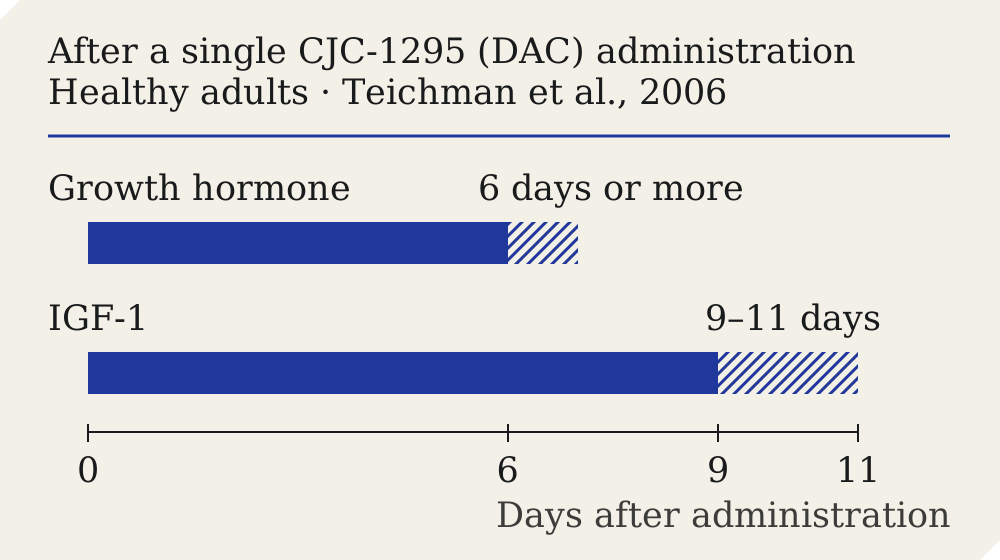
The hormone measurements are a separate kind of duration. In healthy adults, growth hormone remained raised for 6 days or more and IGF-1 for 9–11 days after a single administration. The study’s observation windows are easier to compare on the scale below. A measured hormone response and the peptide’s half-life describe different things.
Mod GRF (1-29)
Mod GRF (1-29), often called CJC-1295 without DAC, lacks the albumin-binding addition. Its action is short, on the order of minutes to approximately 30 minutes in the research record. The older human-plasma work identified enzymes that rapidly degrade native GHRH, part of the background to designing longer-lasting analogues.
That plasma experiment concerns native GHRH. A standalone human pharmacokinetic study of Mod GRF (1-29) is absent from this record. I treat the long and short forms as different experimental starting points; sharing part of a name cannot reconcile their exposure profiles.
Ipamorelin amounts in animals
The ipamorelin selectivity paper describes rat preparations and swine. In swine, its ED50 for growth hormone release was 2.3 nmol/kg. The amount and species are inseparable. Much of the remaining ipamorelin dose-response literature is also animal work.
No validated human pharmacokinetic profile for ipamorelin is published in this record. Pairing a brief secretagogue response with days of DAC exposure leaves the fixed blend’s total hormone exposure uncharacterized. Neither an animal quantity nor the CJC-1295-alone studies can resolve that gap.
Who received the drugs, and how?
The CJC-1295 healthy-adult experiments used subcutaneous administration, while the older GHRH/GHRP synergy experiment used intravenous administration of related peptides. Route is another condition that disappears easily from a copied quantity.
Personal dosing, reconstitution and injection instructions require medical care. This record supplies no home-use method and no human dose for the blend.
Extrapolation, and who is allowed to do it
Someone has to close the gap the studies left open
If every blend dose is extrapolation from two separate literatures, the question is who performs the extrapolation and who reviews the result. Self-directed use answers both with the same person. Prescription care puts that decision with a licensed U.S. clinician, who assesses the individual request and may refuse it. For the CJC-1295 and ipamorelin blend, Promise Peptides (mypromise.com) lists a compounded prescription product that its clinicians now prescribe after assessment. The service considers U.S. patients only; a given treatment may be offered in one state and absent in another. FDA's safety-risk tables retain ipamorelin acetate in Category 2 for 503B compounding and put CJC-1295 among substances whose nominations were withdrawn. Withdrawal confers no compounding permission, and the compounded product has no FDA approval. This page still declines to name a human dose, and the missing pharmacology study named above stays missing — supervision is a statement about oversight, not a substitute for the trial.